
1.44 PB in a Single Chassis: How the ITPOD-SL401-D60R-G4 Replaces Five 2U Servers
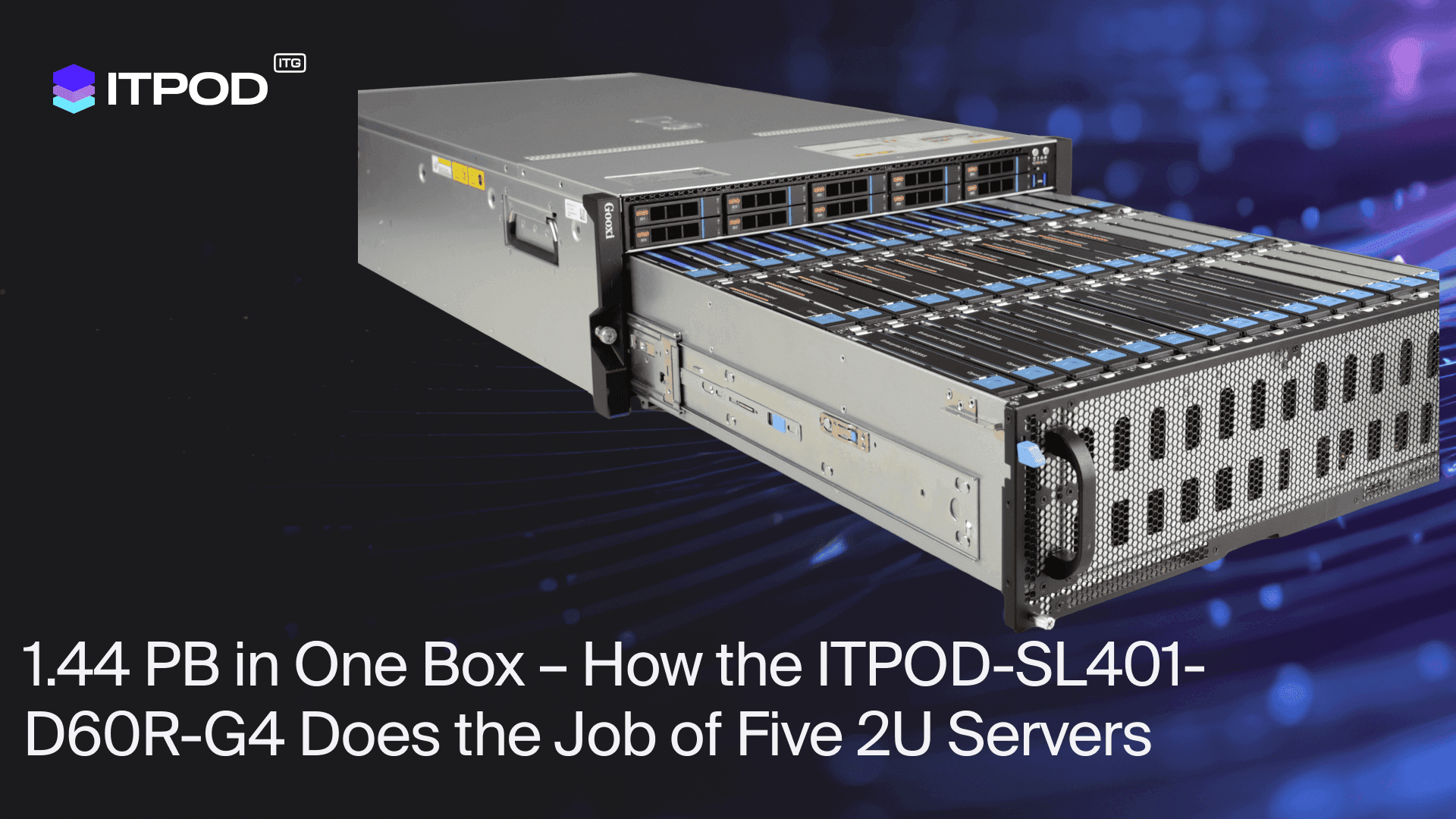
A petabyte of storage deployed on traditional 2U servers with twelve LFF drives occupies five enclosures and ten units, while the number of points of failure and managed nodes increases fivefold. That same petabyte fits into a single 4U chassis if that chassis is an ITPOD-SL401-D60R-G4.
The platform accommodates up to sixty LFF drives with a capacity of up to 24 TB each, providing 1.44 PB of raw capacity per chassis. A rack of ten such units stores 14.4 PB, and the disk density is 2.5 times higher than that of a 2U configuration, with all the resulting implications for rack space rental, power, and cooling. At the same time, this is a standard x86 server, so you can build any software-defined storage solution on it: you choose the software—Ceph, MinIO, NexentaStor, or vStack Unified Storage.
What’s inside the ITPOD-SL401-D60R-G4 platform?
The primary storage tier consists of sixty hot-swappable bays for 3.5" SAS/SATA drives. The front panel also accommodates up to ten 2.5" NVMe drives, and there are four M.2 slots inside the chassis. This flash storage can be used as a cache, as log storage, or as a standalone high-performance pool.
Computing power is provided by two Intel Xeon Scalable Gen5 processors with a TDP of up to 350 W. Thirty-two DDR5 memory slots with speeds of up to 5,600 MT/s provide ample capacity for OSD daemons, deduplication, and compression. Seven PCIe 5.0 slots are available for expansion, including two OCP 3.0 connectors, and network adapters are supported up to 200GbE, so the network will certainly not be a bottleneck.
Continuity of operation is ensured by four CRPS power supplies rated at 1,600 or 2,000 watts with N+N redundancy and fans with N+1 redundancy. Remote management and security are handled by the built-in iBMC controller with IPMI 2.0 support and a TPM 2.0 module.
What kind of SDS should be deployed on a server with 60 drives?
Software-defined storage (SDS) is an architecture in which storage functions are implemented by software running on standard servers, rather than by a specialized hardware array. The choice of software depends on the workload and tasks, and a single platform can cover three typical scenarios.
If your team has mature open-source expertise, deploy Ceph. Each chassis hosts sixty OSDs on HDDs, while WAL logs and BlueStore databases are offloaded to NVMe, ensuring that random writes no longer hit the spindle bottleneck. Thirty-two DDR5 slots provide approximately 4 GB of memory per OSD, with ample headroom. 8+3 erasure coding converts 1.44 PB of raw capacity into roughly 1 PB of usable capacity. The same cluster simultaneously provides RBD block volumes for virtualization, an S3 interface via RGW, and file access via CephFS.
If you need fast S3, go with MinIO. The object layer handles backups, data lakes, and machine learning datasets, with erasure coding operating at the software level, HDDs providing storage capacity, and NVMe handling metadata and small objects. All sixty disks are combined into a single namespace.
If you need scale and the modern NVMe/TCP protocol, choose vStack Unified Storage. RAIDZ2 and RAIDZ3 pools are built on HDDs; built-in error correction, compression, deduplication, and support for development snapshots are available out of the box.
This list is open: TrueNAS SCALE, DAOS, and domestic SDS solutions will run on the platform because the hardware is intentionally software-agnostic, and that is its strength.
NVMe -Not Just a Cache
Ten U.2 bays can accommodate at least 150 TB of flash storage in the same chassis. This capacity can be allocated to cache and logs so that the HDD pool operates faster than typical HDDs, or it can be used to build a separate, ultra-high-performance storage tier—an independent all-flash pool for hot data, databases, or your SDS’s tiering policies. As a result, you get two storage classes in a single chassis and don’t need a second server.
Is the platform suitable as a backup server?
Distributed systems aren’t for everyone. Sixty disks paired with Veeam, Bareos, or Commvault turn into a petabyte-scale repository in a 4U form factor. Hardened repository mode with data immutability protects backups from ransomware, while the NVMe layer accelerates instant recovery and the creation of synthetic full copies. A single such enclosure meets the backup needs of a mid-sized data center.
Conclusion
The storage tier of any architecture—whether it’s Ceph, MinIO, vStack Unified Storage, or conventional backup—ultimately boils down to one question: how many drives can you fit per rack unit and per watt of power. Sixty LFF drives plus ten NVMe drives in a 4U enclosure is a cost-effective solution that doesn’t lock you into any specific software.
#SDS #Ceph #MinIO #vStack #Storage #backup #datacenter #ITPOD