
Evolution instead of revolution: how to upgrade IT infrastructure without breaking processes
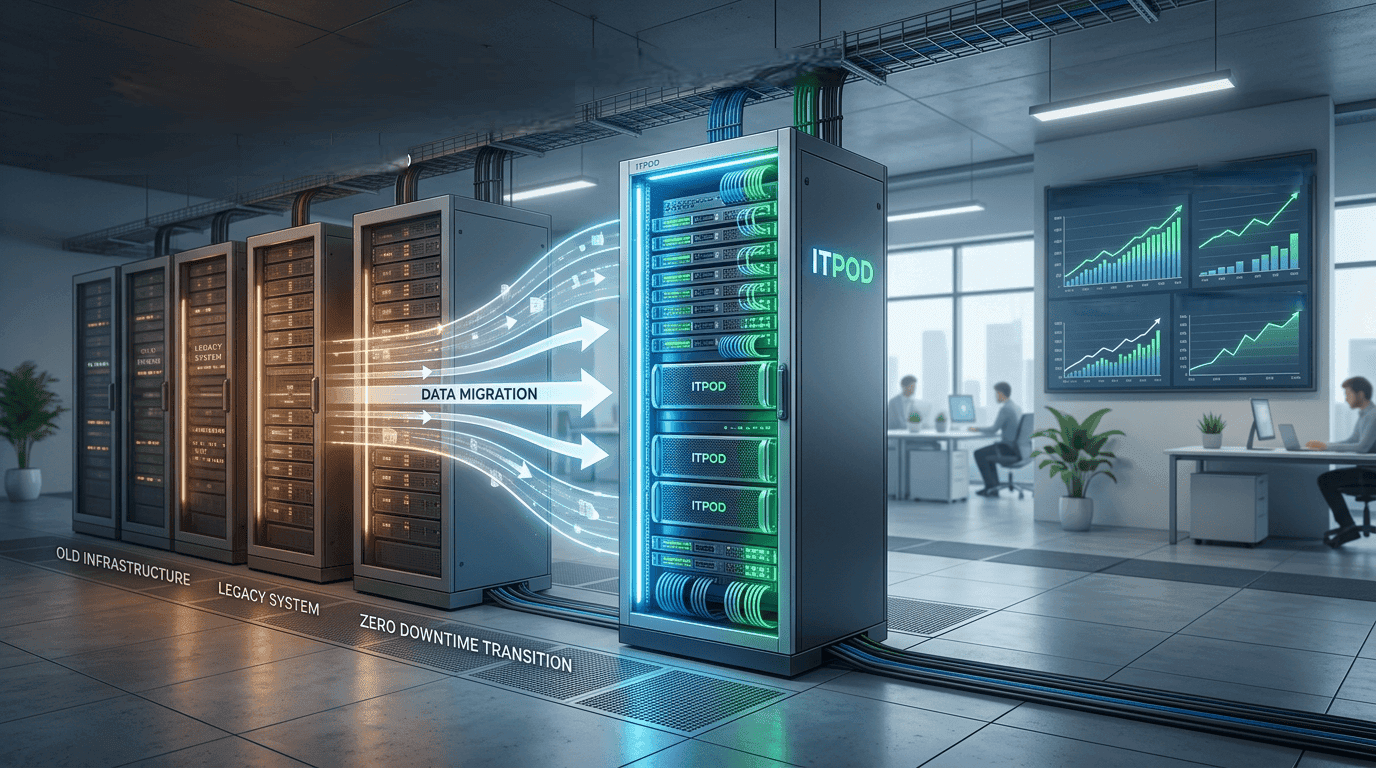
There is a common belief that infrastructure modernization requires a complete and painful replacement of all equipment. In reality, a well-planned upgrade is a controlled process where new server platforms, such as ITPOD servers, are integrated into the existing environment, expanding its capabilities and taking it to the next level.
The key principle: transitioning to a modern infrastructure on the ITPOD platform does not mean an immediate abandonment of existing storage systems (SAN/NAS) or applications. It is a path of smooth transformation where old and new equipment coexist, and migration happens as needed.
Scenario 1: Phased migration from legacy platforms
A common reason to start modernization is the need to move away from aging or economically unviable solutions (e.g., vendor platforms with changing licensing policies). In this case, ITPOD servers become the new target platform.
Advantage of this approach: Migration can be phased and non-disruptive to business processes. Specialized data and virtual machine migration tools (e.g., MIND Migrate) allow workload transfers with zero downtime. At the same time, infrastructure auditing and optimization are happening. This means combining unused resources and updating backup and storage policies.
Scenario 2: Cost optimization and efficient resource utilization
A complete one‑time replacement of the entire infrastructure imposes a huge capital burden. A reasonable alternative is a gradual upgrade strategy:
- New ITPOD servers are deployed for new and mission‑critical projects (analytics systems, databases, development environments), providing high performance and reliability.
- Existing functional systems continue to serve less demanding or legacy workloads: archived data, scheduled storage, specific applications.
This extends the lifecycle of previous investments, while new ITPOD servers become the foundation for a future unified architecture. Old equipment is systematically decommissioned as it reaches the end of its useful life.
Scenario 3: Building a dedicated high‑performance cluster
ITPOD servers are ideally suited for deploying dedicated clusters for specialized tasks without disrupting the main infrastructure:
- High‑performance computing (HPC) and AI systems.
- Isolated development and testing (Dev/Test) environments.
- Analytics platforms and big data systems.
Clusters built on ITPOD servers can be quickly put into operation and scaled. At the same time, they can be integrated into the overall infrastructure, accessing data on existing storage systems via standard mechanisms (e.g., RDM – Raw Device Mapping) when needed.
Conclusion: Strategy, not a forced replacement
Modernizing IT infrastructure with ITPOD servers is a matter of strategic planning, not an emergency replacement. This approach enables you to:
- Preserve investments in still‑functional equipment.
- Minimize risks and downtime through phased migration.
- Improve efficiency by purposefully placing workloads on the platform best suited for them.
- Obtain a modern, manageable, and scalable foundation for digital business transformation.
You are not starting from scratch — you are evolutionarily strengthening your IT environment, making it more flexible, performant, and ready for future challenges.