
Routine storage maintenance: how to protect your infrastructure and extend the life of your data
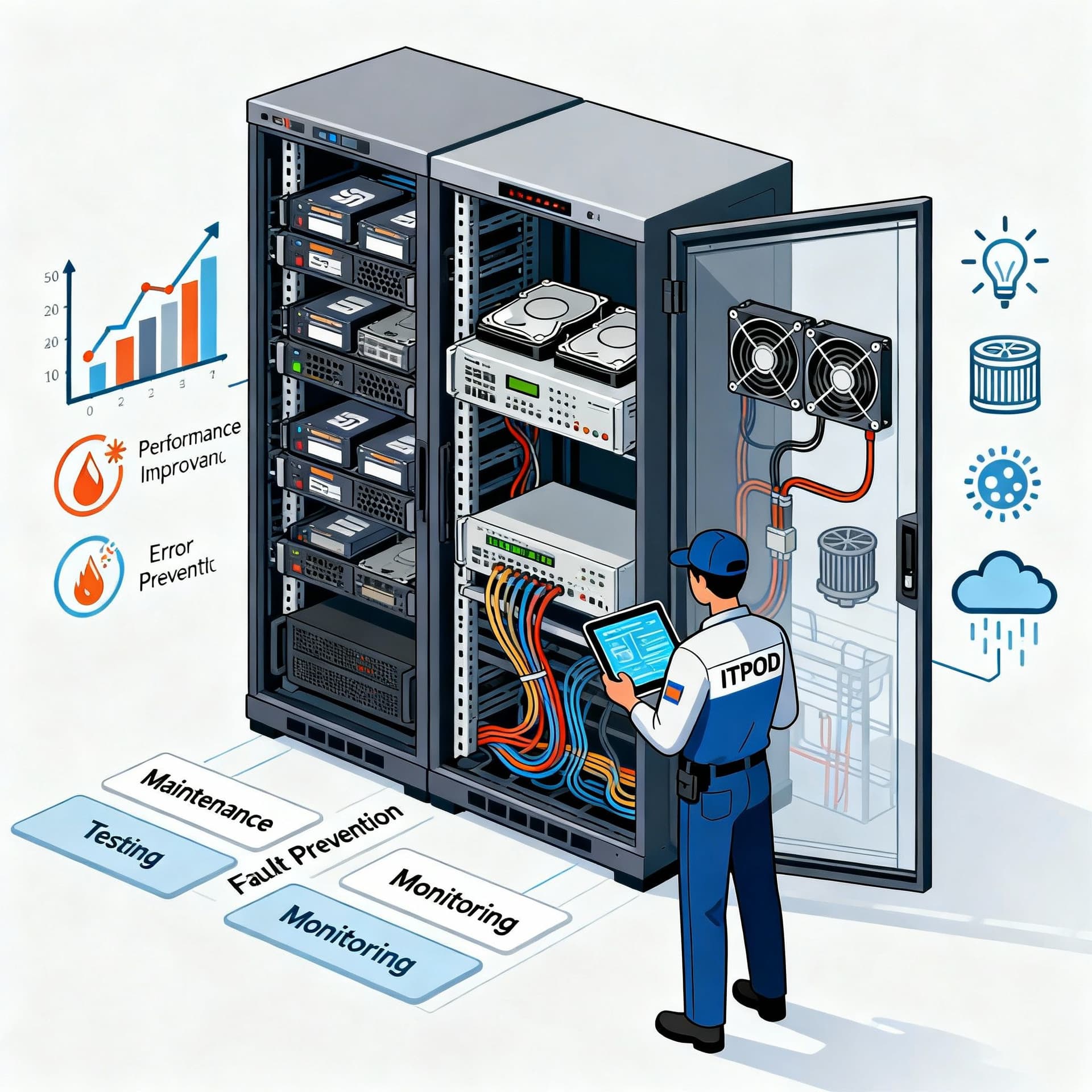
1. Why storage maintenance is the foundation of business sustainability
Modern IT systems are built around data. They provide continuity of services, analytics, and communications. But data reliability is directly tied to the health of the storage system.
Storage systems consist of more than just disks. It includes controllers, cache memory, network adapters, firmware, cooling, cabling and file system-level software logic. Even small failures in one of these parts can lead to chain failures and data corruption.
Typical causes of incidents:
- Gradual performance degradation due to accumulated errors and disk wear.
- Rising temperatures in enclosures when air circulation is compromised.
- Firmware errors resulting in instability or failures after restart.
- Aging controller boards and failed batteries.
Routine maintenance is precisely aimed at preventing such phenomena. It combines hardware checks, software updates and preventive measures to extend the life of components.
In ITPOD this philosophy is enshrined in the preventive maintenance approach - a monitoring and maintenance system with wear prediction and automatic generation of recommendations for engineers and administrators.
2. Key maintenance objectives: not just cleaning, but loss prevention
Storage maintenance performs several key functions:
- Ensuring data integrity.
Checking RAID arrays, pools and block devices for bit errors.
Monitoring SMART monitoring parameters and reacting before actual disk failures occur.
- Maintain high performance.
Optimize caching, load balancing between controllers and storage pools.
Clean internal modules of dust and contaminants that affect cooling.
- Safely upgrade the software stack.
Updating BIOS, BMC, disk microcode and management software versions.
Fixing vulnerabilities fixed in new firmware versions.
- Hardware upgrade planning.
Replacing end-of-life drives based on predictive analytics.
Updating the configuration to meet current business objectives.
ITPOD recommends regular infrastructure analysis not only by life cycle, but also by workload type. For example, a system with intensive write flows (virtualization, databases) requires more frequent SSD health checks than an archive system with infrequent access.
3. Hardware maintenance: details that affect reliability
Physical maintenance is more than just purging hardware. It's a full cycle of actions designed to restore the system to its design operating conditions.
What should be included in the work plan:
- Checking rack temperature and air circulation.
Thermocouples and sensors are used to identify "hot spots" where air is not flowing properly.
- Blowing out cooling systems.
Covers are removed, fans, radiators and filters are cleaned, and worn coolers and cable ties are replaced.
- Checking connections.
Checking the fit of power cables, SAS and NVMe interfaces, fixing SFP-port connectors.
- Inspection of power supplies and UPS.
Check load currents, battery degradation, automatic power switching system.
- Rack vibration measurements.
Excessive vibration shortens the life of disks, so the mounts are checked and the enclosures are leveled.
ITPOD practice shows that physical inspection at least once every six months reduces cases of spontaneous overheating by 70%.
4. Software maintenance: updates, diagnostics, optimization
The software part of maintenance is no less important. Even stable firmware versions require analyzing updates released by the manufacturer.
Key steps:
- Checking and updating BIOS and BMC controllers.
Improves compatibility with new microcode versions and fixes power supply problems.
- SSD and HDD firmware updates.
Often it is microcode bug fixes that prevent sudden disk losses.
- Checking file systems (e.g. ZFS scrub).
Automatic search and recovery of damaged data blocks.
- Optimization of ZIL and cache settings.
Regular checking of SLOG and L2ARC devices eliminates bottlenecks in highly loaded configurations.
- System-level log analysis.
Monitoring of I/O errors, network packet drops, response time.
ITPOD uses AutoSupport functionality for centralized analysis of SMART data from all client storage. It enables prediction of device lifetime and automatic reporting of failure risk level.
5. Fault Tolerance Testing
Often companies believe that redundancy alone guarantees reliability. However, its effectiveness is only proven by tests.
Regular tests include:
- Simulating the failure of controllers or disks in a RAID array.
- Checking the switchover time to a redundant power supply or network port.
- Analyzing the response of cluster services when one of the nodes fails.
- Test of data recovery from backups, including simulation of a complete node failure.
Based on ITPOD services, such tests are performed in a test environment identical to the production environment, without affecting the production subsystem. This allows customers to verify that the backup is actually functioning and not just documented.
6. Typical problems and prevention techniques
Problem | Cause | Effect | Prevention |
| Elevated temperature | Clogged cooling filters | Reduced disk life | Clean and check airflow |
| Controller failure | Chips aging, overheating | RAID pool loss or degradation | SMART check and module replacement |
| Firmware errors | Outdated BIOS/firmware | Accidental reboots | Scheduled upgrade with redundancy |
| L2ARC degradation | SSD cache wear | Read speed degradation | SMART analysis replacement |
| Network path failure | Cable wear, SFP damage | Packet loss, I/O instability | Check and replace optical links |
7. Organization of routines: how often maintenance should be performed
Routines are selected according to the scale and intensity of operation.
- Small companies (SMB): Technical inspection every 6-12 months, backups, basic firmware upgrade, data recovery test.
- Medium-sized organizations: Quarterly inspections, SMART telemetry, management software upgrade, recovery SLA.
- Large enterprises: Continuous telemetry monitoring, monthly audits, equipment degradation prediction.
For mission-critical segments where downtime is unacceptable, ITPOD recommends 24×7 vendor support with a four-hour response time, extended maintenance certifications, and rapid component replacement. More details can be found on the support page.
8. Practical maintenance cases
Case 1. Preemptive SSD replacement before pool degradation.
One of the customers telemetry revealed an increase in read errors on a caching SSD device. According to SMART and log analysis, the drive was in the NAND cell degradation stage. The replacement was performed two days before the actual failure, preventing degradation of the 300TB pool.
Case 2: Restoring performance after overheating.
A routine inspection revealed a clogged cooling system on the rack top units. After cleaning and reconfiguring airflow, the temperature was reduced by 11°C and performance increased by 18%.
These examples prove that prevention is always cheaper than repair.
9. Benefits of implementing system maintenance
- Reduction of emergency downtime and incidents by 50-70% due to timely identification of problems.
- Stable operation of business applications, virtual machines and databases due to optimal storage performance.
- Ability to plan equipment replacement in advance and budget for upgrades without unplanned expenses.
- Minimize risks of downtime and fines for data protection violations.
- Increase overall IT efficiency with up-to-date firmware, improved security and regular configuration audits.
10. Conclusion: Maintenance as an element of storage strategy
Scheduled storage maintenance is not an optional extra, but an essential element of a mature IT architecture. It maintains reliability, prevents failures, preserves data and reduces operating costs.
ITPOD views maintenance as an investment in business sustainability. With comprehensive monitoring and predictive analyzers, maintenance becomes a managed process rather than an incident response.
At the same time, it is important to remember that even if all regulations and updates are followed, it is impossible to completely eliminate the risk of unplanned failures - for example, due to sudden equipment failure or external factors. Therefore, ITPOD recommends purchasing comparable vendor support that provides quick response, qualified diagnostics, component replacement, and engineer on-call.
This approach combines scheduled preventive maintenance with a robust response mechanism to minimize potential lost time and resolve equipment problems as quickly as possible.
Routine maintenance and technical support should be considered as one part of the corporate IT strategy - along with backups, upgrades and performance analysis.